GP
Great PlasticsEngineering Materials & Custom Parts
PEEK plastic material
Choose PEEK plastic for heat, chemicals, wear and precision machined parts.
Review PEEK material properties, grade choices, stock shapes, application fit and machining risks before you send a drawing for
PEEK sheet, rod, tube, blanks or custom plastic parts.
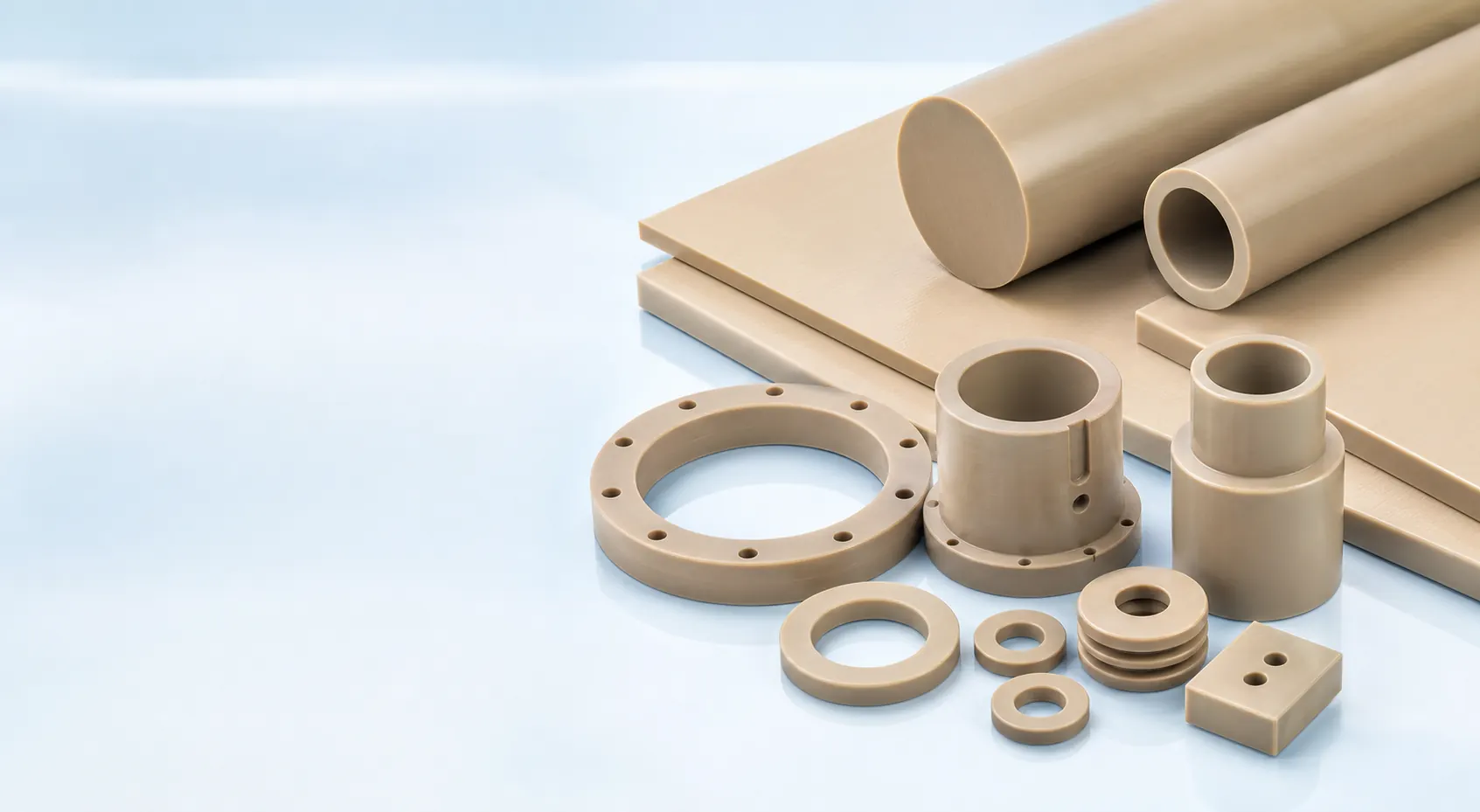
Short answer
PEEK is usually chosen when ordinary engineering plastics are not enough.
PEEK, short for polyether ether ketone, is a high-performance engineering plastic used for demanding thermal, chemical, mechanical and
electrical environments. It is often selected for machined parts when PPS, PEI, POM, Nylon or PTFE cannot provide the right balance of
strength, stability, wear performance and temperature resistance.
Property snapshot
PEEK properties to confirm before choosing sheet, rod or a machined part.
| Property area | Why it matters for PEEK parts | What to specify in the RFQ |
|---|---|---|
| Temperature | PEEK is often selected for elevated service temperature, but thermal cycling and local heat can affect fit and stress. | Continuous temperature, peak temperature, cycle frequency and contact media. |
| Chemical exposure | PEEK is valued for chemical resistance, but concentration, temperature and exposure time still change the decision. | Chemical name, concentration, fluid temperature, cleaning method and exposure duration. |
| Wear and load | Sliding parts may need filled or bearing grades rather than virgin PEEK. | Load, speed, lubrication, mating material, duty cycle and allowable wear. |
| Dimensional stability | Precision PEEK parts can be affected by stock stress, machining heat, wall thickness and feature layout. | Critical dimensions, tolerance class, flatness, inspection method and annealing requirement. |
| Grade and documentation | Virgin, glass-filled, carbon-filled, bearing, medical or food-related grades do not behave the same. | Target grade, color, certificate needs, regulatory expectations and replacement constraints. |
Material fit
Use PEEK when the operating conditions justify the cost and machining care.
| Decision point | Why PEEK may fit | RFQ question to answer |
|---|---|---|
| Heat resistance | PEEK is considered for elevated-temperature service and repeated thermal cycling where many lower-cost plastics lose stiffness. | What are the continuous temperature, short-term peaks and contact conditions? |
| Chemical resistance | PEEK is used in fluid handling, chemical processing and cleaning environments when chemical attack is a key failure risk. | Which chemical, concentration, temperature and exposure duration apply? |
| Wear and friction | PEEK can be used for bushings, bearings, seats, rings and wear parts, especially when filled grades are evaluated. | What are the load, speed, mating surface and lubrication conditions? |
| Dimensional stability | PEEK is useful when the drawing requires stability after machining, heat exposure or assembly. | Which dimensions are truly critical, and is annealing or inspection required? |
| Electrical insulation | PEEK is often evaluated for insulators, spacers, semiconductor components and electrical fixtures. | Are dielectric, ESD, flame, cleanliness or documentation requirements specified? |
Grade selection
Do not quote PEEK by name only. Grade and form change the part behavior.
Virgin PEEK
A common starting point when the project needs balanced mechanical strength, chemical resistance, insulation and machinability.
Glass-filled PEEK
Consider when stiffness and dimensional stability are more important than maximum ductility or ease of machining.
Carbon-filled PEEK
Often reviewed for wear, stiffness and thermal conductivity, with more attention to tooling, finish and edge quality.
Bearing / wear grades
Useful when the design involves sliding, friction, load or mating surfaces that need more than unfilled PEEK.
Medical or food-related grades
Only specify when documentation and grade traceability match the application. Do not assume compliance from the polymer name alone.
Sheet, rod, tube or molded blank
Stock form affects cost, lead time, grain direction, stress, material removal and whether the part can hold tolerance efficiently.
Manufacturing route
PEEK parts should be designed around the manufacturing route, not only the material datasheet.
CNC machining from stock shapes
Best for prototypes, precision parts and low-to-medium quantities. Review fixturing, burr control, heat buildup, annealing and inspection before final quote.
Cut blanks, sheet, rod and tube
Useful when the buyer needs machining-ready stock or simplified purchasing. Confirm size, grade, color, certificate needs and cut tolerance.
Molding or production planning
Consider molding when annual volume and geometry justify tooling. Check wall thickness, shrinkage, gate position, crystallinity and part qualification.
PEEK vs alternatives
Compare PEEK against nearby materials before locking the drawing.
| Compare with | When the alternative may win | When PEEK may still be needed |
|---|---|---|
| PPS | Cost-sensitive chemical parts, stable molded components and applications that do not need PEEK-level mechanical performance. | Higher mechanical load, wear, toughness or broader performance balance. |
| PEI / Ultem | Electrical insulation, stiffness, flame needs and transparent or amber stock-shape applications. | Chemical resistance, wear and high-temperature mechanical stability are more important. |
| PAI / Torlon | High-load wear parts where creep resistance and bearing performance dominate. | A more balanced material is needed for chemicals, heat, machining and availability. |
| PI / Polyimide | Very high-temperature stability and severe thermal environments. | Melt-processability, stock shape sourcing or broader machined-part practicality matters. |
| POM, Nylon, PTFE, PVDF | The environment is moderate enough that a lower-cost engineering plastic meets the requirement. | Heat, load, chemical resistance, wear or dimensional stability exceed the practical limit of the lower-cost material. |
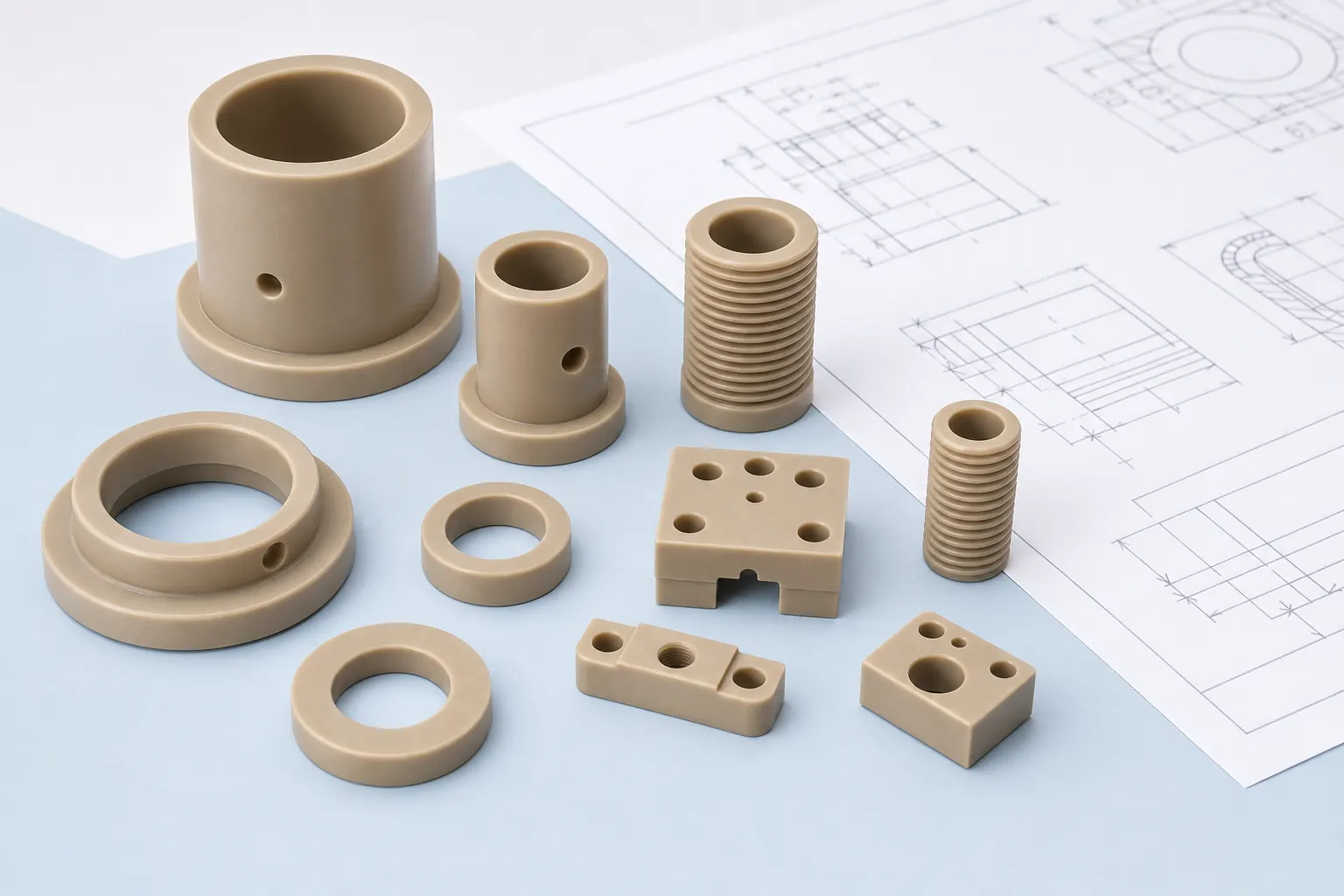
Drawing review
Small drawing choices can make a PEEK part easier or riskier to machine.
PEEK is not difficult because it is impossible to machine; it is difficult when heat, residual stress, thin walls, sharp corners or
unrealistic tolerances are ignored. Send the drawing before final release if the part has tight fits, sealing surfaces or high-value
material removal.
- Mark critical dimensions separately from general dimensions.
- Confirm whether annealing, first-article inspection or material certificates are required.
- Avoid deep narrow pockets, unsupported thin walls and sharp internal corners when possible.
- Share chemical, heat, load, sliding and cleaning conditions so substitutions are reviewed correctly.
Application matrix
Typical PEEK plastic part discussions start here.
| Application area | Common PEEK part types | Review before quote |
|---|---|---|
| Semiconductor and electronics | Insulators, rings, fixtures, spacers, carriers and test components. | Cleanliness, ESD, temperature, chemical cleaning and dimensional stability. |
| Chemical processing and fluid handling | Valve seats, seals, manifolds, pump wear parts, bushings and fittings. | Chemical concentration, fluid temperature, pressure, sealing surface and creep. |
| Medical, lab and sterilization equipment | Instrument parts, trays, spacers, housings, handles and precision components. | Grade documentation, sterilization method, cleaning exposure and inspection needs. |
| Aerospace, energy and industrial equipment | Lightweight metal-replacement parts, wear pads, rollers, guides and structural insulators. | Temperature cycle, vibration, load, safety factor and traceability expectations. |
Related pages
Continue from PEEK selection to sourcing and manufacturing.
FAQ
Questions buyers ask before sourcing PEEK plastic.
What is PEEK plastic?
PEEK plastic, or polyether ether ketone, is a high-performance semi-crystalline thermoplastic used when heat resistance, chemical resistance, wear performance and dimensional stability are important.
What are the main PEEK plastic properties to review?
Review heat resistance, chemical resistance, wear behavior, creep, stiffness, electrical insulation, moisture behavior, dimensional stability and machinability. The correct grade depends on the operating environment.
Can PEEK plastic be CNC machined?
Yes. PEEK is often machined from sheet, rod, tube or plate for prototypes and precision custom parts. Grade, fixturing, heat control, annealing and inspection requirements should be reviewed before quoting.
When should I choose PEEK instead of PPS, PEI or PAI?
Choose PEEK when the part needs a strong balance of heat resistance, chemical resistance, stiffness, wear performance and machinability. Compare PPS for cost-sensitive chemical parts, PEI for electrical/flame needs and PAI for high-load wear conditions.
Why is PEEK plastic expensive?
PEEK is a high-performance polymer, and stock shape, grade, certificate requirements, machining time, material removal and inspection can all affect cost. A drawing review helps avoid over-specifying the material.
What information is needed to quote PEEK machined parts?
Send a 2D drawing or 3D model, target grade, dimensions, tolerance, quantity, operating temperature, chemical exposure, load, surface finish, inspection needs and target lead time.
RFQ checklist
Ready to quote PEEK sheet, rod or custom machined parts?
Include drawing or 3D model, target PEEK grade, dimensions, tolerance, quantity, operating temperature, chemical exposure, load, surface finish, inspection needs and lead time.