GP
Great PlasticsEngineering Materials & Custom Parts
Datasheet workbench
Engineering plastic datasheets for material selection, property comparison and RFQ review.
Use the tables below to compare PEEK, PPS, PEI, PAI, PI and other engineering plastics by heat, CTE, chemical exposure, wear, electrical needs, stock form and drawing requirements.

Short answer
Start with the datasheet, then turn the numbers into a manufacturable part specification.
Datasheets are useful when they are connected to a real drawing. A good review compares material family, grade, stock shape, CTE, temperature range, chemical exposure, tolerance, inspection and production route before the RFQ moves forward.
Datasheet finder
Select the right datasheet family before comparing values.
| Material family | Best first use case | Datasheet fields to compare | Manufacturing route | Related page |
|---|---|---|---|---|
| PEEK | High heat, chemical resistance, hydrolysis, wear and precision parts. | CTE, tensile strength, modulus, HDT, wear grade, filler package. | CNC machining, molded parts, rod, sheet, tube. | PEEK plastic |
| PPS | Chemical-resistant parts where PEEK may exceed the requirement. | Service temperature, chemical resistance, dimensional stability, moisture. | Machining, molding, sheet, rod. | PPS plastic |
| PEI | Electrical insulation, stiffness, flame behavior and stable machined parts. | Dielectric strength, modulus, HDT, moisture, transparency or color. | Machining, molding, sheet, rod, filament. | PEI plastic |
| PAI | High-load wear surfaces, bushings, rollers and mechanical components. | Compressive strength, creep, friction, wear grade, heat aging. | Precision machining from rod or plate. | PAI plastic |
| PI | Extreme heat, wear, dimensional stability and demanding insulation parts. | Temperature class, thermal stability, wear, outgassing, electrical behavior. | Machined shapes, formed components, high-value precision parts. | PI plastic |
| PTFE / PVDF / POM / Nylon / PC | Broader engineering plastic selection for chemical, wear, cost or impact needs. | Chemical chart, moisture, hardness, impact, machinability, cost band. | Machining, cutting, molding, stock shapes. | Other plastics |
Property table
Typical comparison values used for early material screening.
| Material | Density g/cm3 | Tensile strength MPa | Service temp C | CTE x10-5/K | Moisture behavior | Commercial note |
|---|---|---|---|---|---|---|
| PEEK | 1.30-1.45 | 90-110+ | Up to 250 | 4.5-5.5 unfilled; lower with fillers | Low | High-performance choice for heat, chemical and wear requirements. |
| PPS | 1.34-1.65 | 80-150 | Up to 200 | 3.0-5.0 grade dependent | Very low | Strong chemical option when the part does not need PEEK cost level. |
| PEI | 1.27-1.51 | 95-150 | Up to 170 | 4.5-6.0 grade dependent | Moderate | Useful for stiff electrical and structural components. |
| PAI | 1.40-1.47 | 110-190 | Up to 250 | 2.5-3.5 grade dependent | Moderate | Premium wear and load material for precision machined components. |
| PI | 1.40-1.45 | 80-170 | 250+ | 2.0-5.0 grade dependent | Low to moderate | Selected for severe temperature, wear or specialty insulation use. |
| PTFE | 2.10-2.20 | 20-35 | Up to 260 | 10-13 typical | Very low | Excellent chemical and low-friction option with lower structural strength. |
Data cards
Move from property data to a quote-ready specification.
Temperature range
Record continuous temperature, peak temperature, thermal cycling and the time spent at each condition.
CTE and tolerance
Compare expansion against part length, mating material, assembly clearance and functional datums.
Media exposure
List chemicals, concentration, cleaning agents, fluid temperature and whether the part is loaded in contact.
Load and wear
Capture static load, dynamic load, speed, shaft material, lubrication and expected wear surface.
Insulation needs
Define voltage, humidity, clearance, flame behavior, ESD requirement and any document package.
Stock shape
Choose sheet, rod, tube, plate, filament or molded route according to geometry, quantity and cost target.
CTE table
Use thermal expansion data with assembly and tolerance notes.
| CTE review point | Part risk | Datasheet input | Drawing input |
|---|---|---|---|
| Filled vs unfilled PEEK | Different expansion, stiffness and wear behavior. | Grade name, filler type, test method. | Critical surfaces, wear face, machining orientation. |
| Large plate or long rail | Thermal movement can affect flatness and hole position. | CTE range, service temperature, modulus. | Datum scheme, flatness, length tolerance, mounting method. |
| Ring, bushing or sleeve | Clearance can tighten or loosen in service. | CTE, compressive strength, wear grade. | ID, OD, shaft material, load, speed, press fit or slip fit. |
| Plastic-to-metal assembly | Expansion mismatch can load fasteners or sealing faces. | CTE, operating temperature, creep behavior. | Fastener pattern, gasket, metal material, service cycle. |
| Electrical insulator | Dimensional drift can affect clearance and creepage distance. | CTE, dielectric data, moisture behavior. | Voltage, clearance, humidity, fixture geometry. |
Manufacturing path
Connect datasheet data to the production method.
Stock shape review
Select sheet, rod, tube, plate or filament according to part envelope, grain/orientation sensitivity and machining yield.
CNC machining review
Translate material behavior into tolerances, corner radii, wall thickness, burr control and inspection plan.
Production route review
Use machining for prototypes and lower volumes; consider molding or printing when geometry, quantity and validation support it.
Application matrix
Turn a datasheet comparison into a material shortlist.
| Application requirement | Materials to compare | Key datasheet values | RFQ detail to provide |
|---|---|---|---|
| High temperature structural part | PEEK, PAI, PI, PEI | Service temperature, modulus, creep, HDT, CTE. | Temperature cycle, load direction, critical dimensions. |
| Chemical fluid component | PEEK, PPS, PTFE, PVDF | Chemical resistance, moisture, temperature, dimensional stability. | Fluid, concentration, pressure, cleaning method. |
| Wear pad, bushing or roller | PAI, PEEK, PI, POM, Nylon, PTFE filled grades | Compressive strength, friction, wear grade, creep. | Load, speed, shaft material, lubrication, target life. |
| Electrical insulation component | PEI, PEEK, PI, PPS, PC | Dielectric strength, resistivity, flame behavior, moisture. | Voltage, clearance, humidity, flame or document needs. |
| Precision machined fixture | PEEK, PPS, PEI, POM, PET | CTE, moisture, machinability, modulus, dimensional stability. | Datum scheme, flatness, surface finish, inspection level. |
Datasheet request workbench
Build a cleaner material request before sending the drawing.
Read the datasheet around the part, not only the polymer name.
A useful datasheet request combines material family, grade, stock shape, operating environment and the drawing features that decide performance.
- For CTE questions, include part length, fit, mating material and temperature swing.
- For strength questions, include load direction, wall thickness, creep risk and service time.
- For chemical questions, include chemical name, concentration, temperature and cleaning cycle.
- For document requests, separate typical datasheets from batch certificates, inspection reports and traceability needs.
Drawing review
Bring datasheet values into the part drawing.
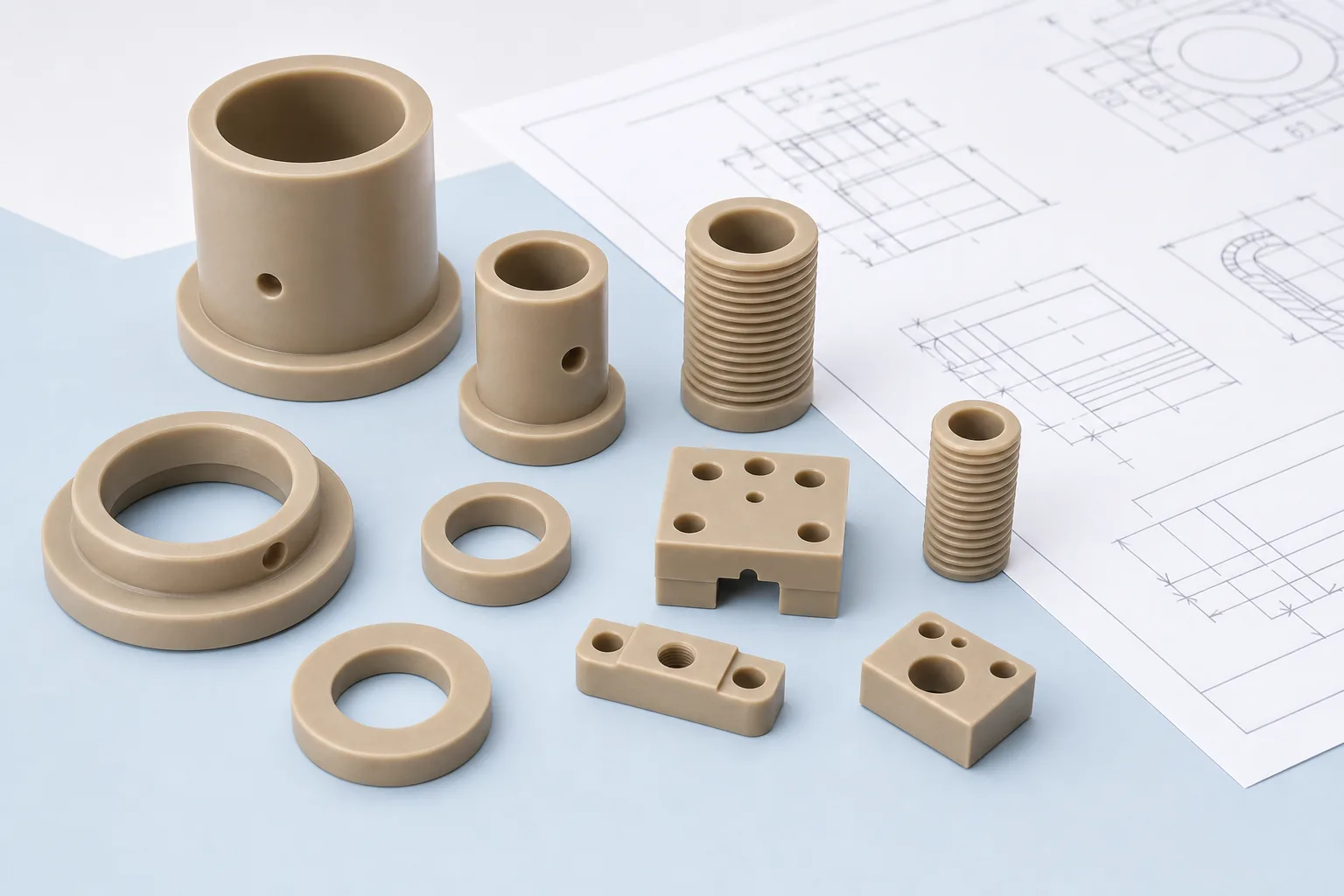
Great Plastics reviews the selected material against part geometry, stock form and manufacturing route. The strongest RFQs combine property requirements with drawings, operating conditions and commercial quantities.
- Mark critical dimensions, datums, mating faces and sealing surfaces.
- List operating temperature, chemicals, load, speed, humidity and cleaning method.
- Define stock form preference: sheet, rod, tube, plate, filament, molded part or machined component.
- State required certificate, inspection, packing and traceability documents in the RFQ.
Related pages
Continue the engineering review.
FAQ
Questions buyers ask before using datasheet values.
What is an engineering plastic datasheet?
An engineering plastic datasheet gives material property values, test methods, grade notes and processing context for a plastic such as PEEK, PPS, PEI, PAI or PI. Engineers use it to compare materials before drawing review and quotation.
Which datasheet should I compare first for a high temperature plastic part?
Start with PEEK, PPS, PEI, PAI and PI when the part has heat, chemical, wear, electrical or dimensional stability requirements. Add PTFE, PVDF, POM, Nylon or PC when the operating conditions allow a broader material search.
How do I use coefficient of thermal expansion data from a PEEK datasheet?
Use the CTE value with the stated temperature range, grade, filler package, stock form and part geometry. For rings, plates, bearing surfaces and long parts, thermal movement should be checked against mating materials and assembly clearance.
Can Great Plastics quote custom plastic parts from datasheet requirements?
Yes. Send the drawing or 3D model, material target, key property requirements, dimensions, tolerance, quantity, operating environment, finish and documentation needs for RFQ review.
What is the difference between a datasheet and a certificate?
A datasheet lists typical material behavior for a grade or product family. A certificate is tied to a supplied batch, document package or project requirement.
What fields should I include in a datasheet request?
Include material family, grade if known, stock form, operating temperature, chemicals, load, wear or insulation needs, part dimensions, tolerance, quantity, inspection level and target lead time.
RFQ checklist
Send a drawing, datasheet target and operating data in one request.
Include drawing or 3D model, preferred material, required property values, quantity, dimensions, tolerance, temperature, chemicals, load, wear, electrical requirements, surface finish, inspection and target lead time.