High-performance plastics material selection
High-performance plastics for specialized heat, chemical, wear and electrical requirements.
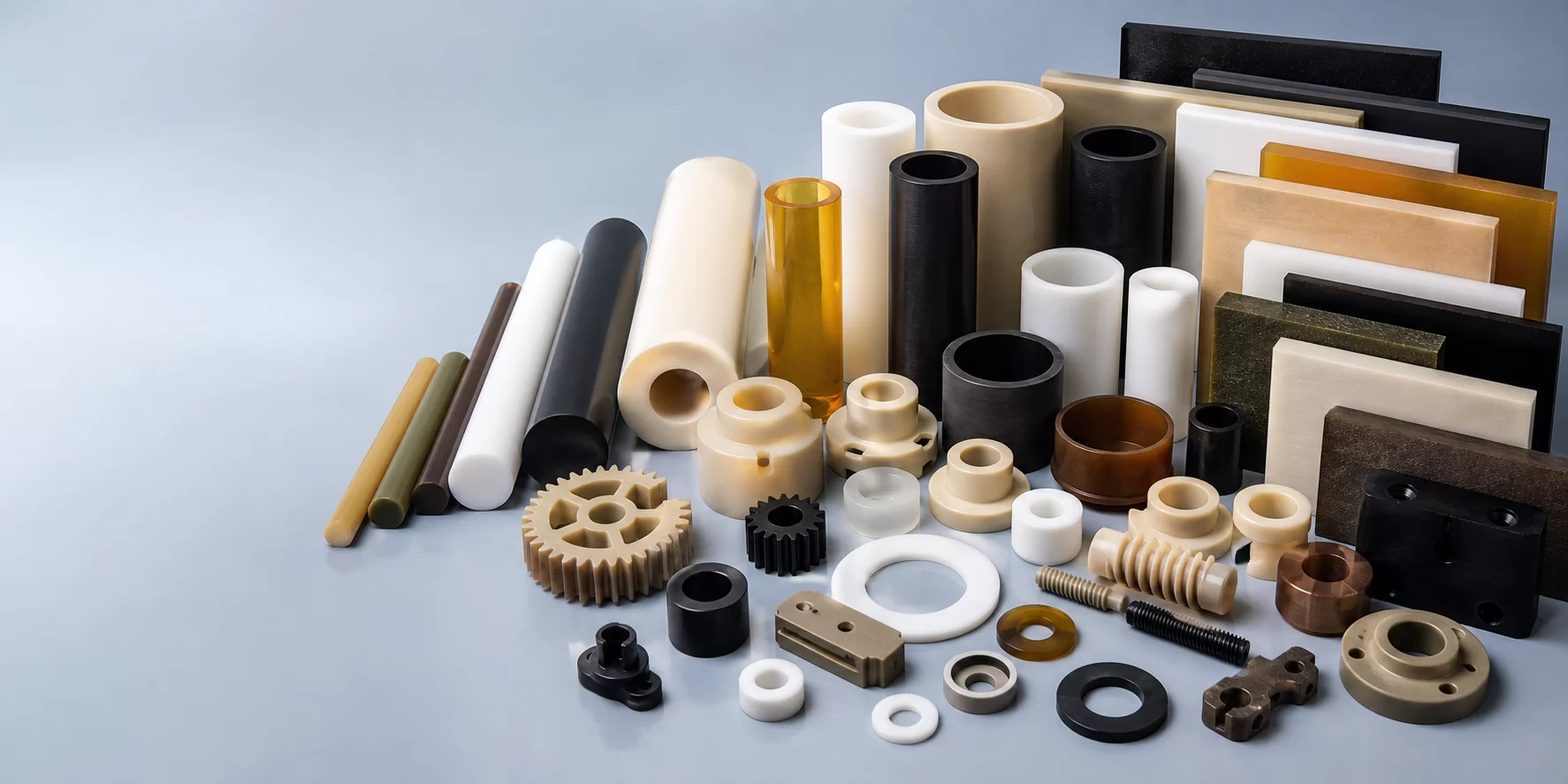
Compare PTFE, PVDF, POM, Nylon, PSU, PPSU and related engineering plastic families before moving into a custom part, stock shape or CNC machining RFQ.
Short answer
Use this page when the project needs a material shortlist, not just a datasheet.
High-performance plastics are chosen by matching the service environment to a practical manufacturing route. Start with heat, chemicals, load, wear, moisture, electrical behavior, tolerance and quantity. Then compare the broader material family against dedicated pages for PEEK, PPS, PEI, PAI and PI.
Material family map
Choose by polymer family before choosing a part material.
High-performance plastics cover several very different material families. A fluoropolymer part, a precision acetal part and a steam-resistant sulfone part may all be described as high-performance plastics, but they solve different problems. Use the family map to narrow the discussion before selecting a grade, stock shape or custom manufacturing route.
Fluoropolymers
PTFE and PVDF for chemical contact, low friction, non-stick surfaces and fluid-handling parts.
Ask about chemicals, temperature, pressure and deformation limits.
Precision and wear plastics
POM and Nylon/PA for gears, rollers, wear pads, guides, jigs and machined mechanical parts.
Ask about load, humidity, sliding contact and tolerance.
Sulfone plastics
PSU, PPSU and PES for hot water, steam, sterilization exposure, electrical insulation and stable components.
Ask about sterilization, transparency, impact and electrical needs.
High-temperature aromatic plastics
PEEK, PPS, PEI, PAI and PI for long-term heat, chemical load, stiffness or dimensional stability risk.
Use the dedicated material pages for deeper grade review.
Material router
Start with the requirement that can make the part fail.
| Material family | Best first-fit reason | Common forms or parts | RFQ note |
|---|---|---|---|
| PTFE | Low friction, non-stick behavior and broad chemical resistance where mechanical load is moderate. | Seals, gaskets, valve seats, bushings, liners, tubes and washers. | Send chemical, temperature, pressure, mating surface and deformation limits. |
| PVDF | Chemical resistance with better handling and mechanical behavior than many soft fluoroplastics. | Pump parts, chemical fittings, manifolds, sheets, rods, gaskets and semiconductor fluid parts. | Define chemical concentration, cleaning method, temperature and purity expectations. |
| POM / Acetal | Dimensional control, machinability, low friction and mechanical precision at reasonable cost. | Gears, rollers, guides, wear pads, bushings, jigs and precise machined parts. | Define tolerance, moisture exposure, sliding contact and production quantity. |
| Nylon / PA | Wear, toughness, impact resistance and cost-effective mechanical parts. | Rollers, wheels, guide rails, pads, bushings, wear strips and structural parts. | Send humidity, load, impact, wear path and dimensional stability requirements. |
| PSU / PPSU / PES | Hot water, steam, sterilization, electrical insulation or transparent amber engineering parts. | Medical fixtures, electrical housings, manifolds, sterilization components and insulating parts. | Define repeated steam, cleaning chemicals, transparency and regulatory needs. |
| PET / PC / UHMW-PE | Targeted alternatives when impact, sliding, wear, clarity or cost matters more than extreme heat. | Wear strips, guards, rollers, transparent covers, guide rails and packaging fixtures. | Use these to avoid over-specifying premium high-temperature materials. |
Selection path
A practical selection path reduces expensive material mistakes.
Competitor pages often list polymer names. Buyers still need to connect those names to failure modes. The shortlist should move from service condition to manufacturing route, then to quote details.
| Question | What it separates | Where to go next |
|---|---|---|
| Is heat the dominant issue? | Commodity and mid-range plastics from high-temperature families. | PEEK, PPS, PEI, PI or PAI. |
| Is chemical exposure dominant? | Fluoropolymers, PPS, PEEK and chemical-resistant engineering plastics. | PTFE, PVDF, PPS or PEEK based on load and temperature. |
| Is sliding wear dominant? | Soft low-friction materials from load-bearing plastics. | PTFE, filled PEEK, PAI, Nylon, POM or UHMW-PE. |
| Is tolerance dominant? | Stable machinable stock shapes from moisture-sensitive or soft materials. | POM, PEEK, PPS, PEI or PAI depending on temperature and load. |
| Is cost or availability dominant? | Over-specified premium materials from practical alternatives. | POM, PET, Nylon, PC or PPS before PEEK/PI/PAI. |
Manufacturing route
Material choice should match the part route, not only the property table.
Application matrix
Match the environment before choosing the polymer name.
| Application condition | Likely shortlist | Design check |
|---|---|---|
| Chemical fluid contact | PTFE, PVDF, PPS, PEEK | Chemical name, concentration, temperature, pressure and seal geometry. |
| Bearing, roller or guide motion | POM, Nylon, UHMW-PE, filled PEEK, PAI | PV value, mating surface, lubrication, wear debris and creep. |
| Electrical or semiconductor fixture | PEI, PPS, PEEK, PVDF, PSU/PPSU | Dielectric requirement, outgassing, cleaning, thermal cycling and precision holes. |
| Medical or sterilization exposure | PPSU, PEI, PEEK, PTFE | Steam cycles, cleaning chemistry, documentation and color or transparency needs. |
| Food or packaging machinery | POM, PET, Nylon, UHMW-PE, PTFE, PEEK | Contact requirement, wear, cleanability, impact and replacement interval. |
| Metal replacement | PEEK, PAI, PPS, POM, Nylon, reinforced grades | Load path, stiffness, temperature, creep, fasteners and tolerance stack. |
Avoid over-specifying
Not every demanding part needs the most expensive plastic.
| If the buyer says | Do not jump directly to | Review this instead |
|---|---|---|
| It needs chemical resistance. | PEEK or PTFE only. | PVDF, PPS, PE, PP or PTFE depending on load, temperature and chemical concentration. |
| It needs low friction. | PTFE only. | POM, Nylon, UHMW-PE, filled PEEK or bearing-grade PAI depending on load and speed. |
| It needs high temperature. | PI or PAI only. | PPS, PEI, PEEK, PPSU or PI based on continuous temperature and mechanical load. |
| It needs tight tolerance. | The highest-performance resin. | POM, PPS, PEEK or PEI based on moisture, thermal movement and machining stability. |
| It replaces metal. | A premium polymer without design review. | Check wall thickness, creep, fastening, stiffness, temperature and wear first. |
RFQ checklist
Send the inputs that make material selection faster.
| RFQ input | Why it matters | Example detail |
|---|---|---|
| Drawing or 3D model | Defines geometry, tolerance, wall thickness, machining access and inspection scope. | PDF drawing, STEP file, critical dimensions and mating parts. |
| Material target or problem | Allows a material family to be compared instead of guessing from a single resin name. | PTFE alternative, POM gear, PVDF fluid component or unknown material for chemical service. |
| Operating environment | Connects material behavior to heat, chemicals, moisture, UV, steam or electrical exposure. | Chemical name, concentration, temperature, pressure and cleaning cycle. |
| Mechanical load and motion | Separates low-friction parts from load-bearing or creep-sensitive parts. | Load, speed, bearing pressure, duty cycle and mating surface. |
| Quantity and documentation | Controls machining, molding, cutting, inspection and lead-time planning. | Prototype quantity, production quantity, certificate or inspection report needs. |
Related pages
Move from material family to the correct buying page.
FAQ
Questions buyers ask about high-performance plastics.
High-performance plastics RFQ
Send the drawing and service environment for a material shortlist.
A useful quote starts with the part function, not only the polymer name. Share the drawing, material target, operating environment and quantity so the shortlist can be matched to machining, cutting or custom part production.
- Drawing or 3D model
- Material target or performance problem
- Temperature, chemical, load and wear conditions
- Quantity, tolerance and documentation needs