GP
Great PlasticsEngineering Materials & Custom Parts
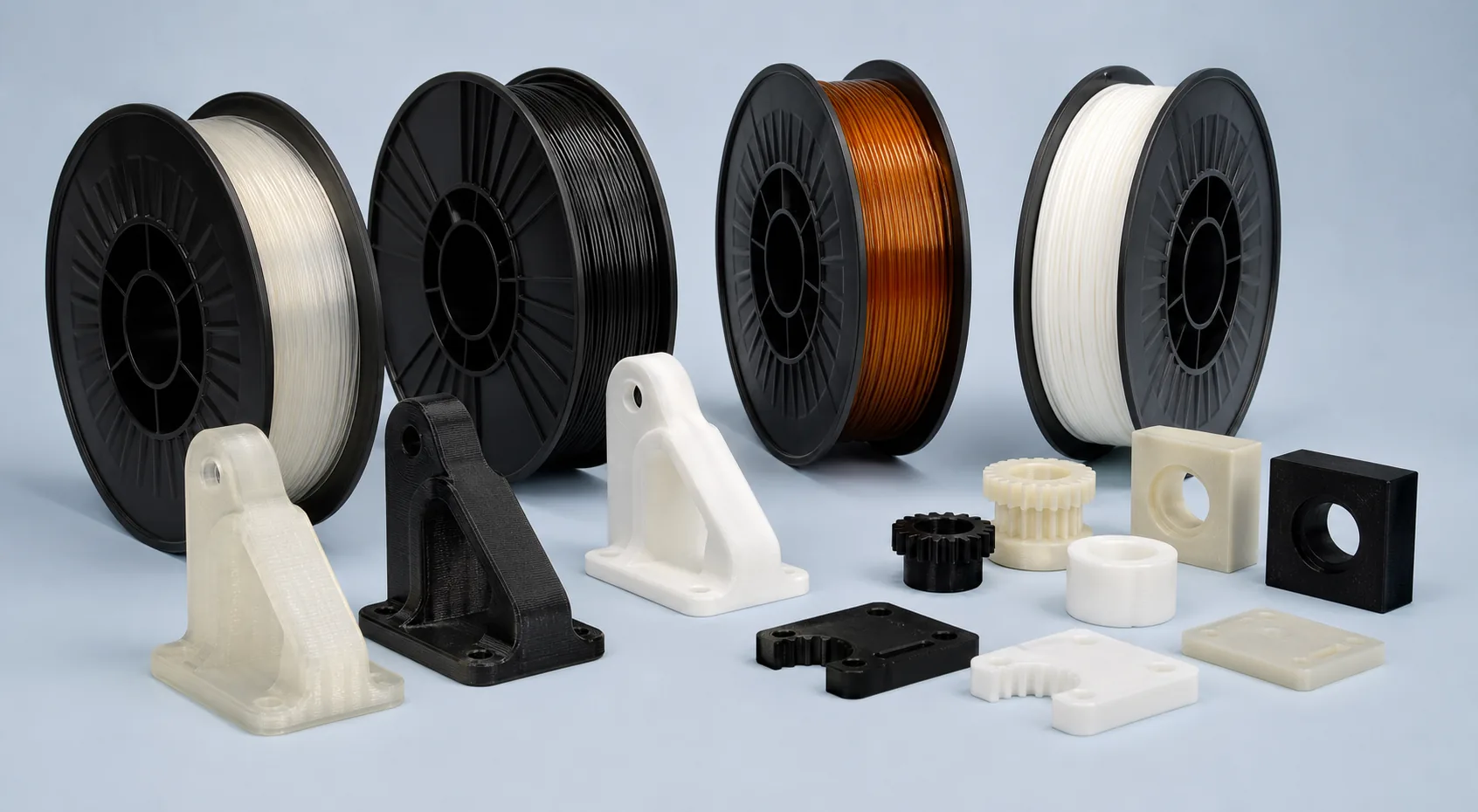
Engineering plastic filament
Review engineering plastic filament for prototypes, fixtures and 3D printed functional parts.
Great Plastics helps buyers decide when filament-based 3D printing is useful, which engineering plastic material family to review, and when a part should move to CNC machining or molding instead.
Prototype and fixture parts
Printer capability and drying
CNC or molding route check

Short answer
Filament is a route decision as much as a material decision.
Engineering plastic filament can help validate fit, airflow, fixture geometry, assembly clearance and selected functional loads before production. It should not be treated as a direct substitute for machined or molded plastic without reviewing layer direction, shrinkage, moisture, heat, surface finish and tolerance.
Material fit
Common engineering plastic filaments and what to check.
| Filament family | Often reviewed for | Confirm before RFQ |
|---|---|---|
| Nylon / PA filament | Functional prototypes, fixtures, clips, housings and wear-resistant trial parts. | Drying, moisture uptake, layer orientation, stiffness, wear and dimensional movement. |
| Carbon fiber Nylon | Stiffer fixtures, tooling aids, brackets and low-volume functional parts. | Anisotropy, abrasive filament handling, surface finish, layer strength and tolerance. |
| PC / PETG / ASA | Impact, transparency, outdoor use, fit checks and general engineering prototypes. | Heat, UV, chemical exposure, dimensional stability and cosmetic expectations. |
| PEI / Ultem filament | High-temperature, flame-resistant and electrical applications where printer capability supports the material. | Chamber temperature, drying, shrinkage, warpage, layer bonding and final documentation needs. |
| PEEK / PEKK filament | Premium high-temperature, chemical-resistant and demanding prototypes or production-intent trials. | High-temperature equipment, crystallinity, annealing, cost, geometry risk and whether CNC is more reliable. |
| PPSU / PSU filament | Steam, hot water, chemical and impact-resistant trials where additive manufacturing is suitable. | Cleaning cycle, print process, shrinkage, dimensional needs and final use environment. |
Selection path
Decide what the printed part must prove.
Fit check
Use lower-risk materials when the part only needs to verify clearance, assembly or package space.
Fixture or jig
Review stiffness, repeated handling, temperature, chemicals, fasteners and replaceable wear areas.
Functional prototype
Review load path, layer direction, creep, impact, moisture and critical dimensions.
High-temperature trial
Review PEI, PEEK, PEKK, PPSU or CNC alternatives when the prototype sees real heat.
Bridge production
Use printing only when quantity, risk and tolerance fit the process; otherwise compare machining or molding.
Material validation
Use printed parts to reduce design risk, then confirm final material behavior through the production route.
Filament RFQ workbench
Turn a 3D printed plastic part request into quote-ready inputs.
Fast filament specification
Use this structure when the buyer needs engineering plastic filament guidance, a printed prototype, a fixture or a bridge-production part.
- Part purpose: proof-of-fit, fixture, functional test, high-temperature trial or bridge production.
- Material target: Nylon, carbon fiber Nylon, PC, PEI, PEEK, PEKK, PPSU or performance-based selection.
- Print requirement: diameter, color, spool size if relevant, layer direction, support concerns and post-processing.
- Use environment: load, heat, chemical contact, moisture, wear, electrical needs and critical dimensions.
Route comparison
When filament printing, CNC machining or molding makes more sense.
| Project condition | Consider 3D printing when | Consider another route when |
|---|---|---|
| Geometry | Complex internal channels, light-load brackets, ergonomic shapes or fixture bodies need fast iteration. | Flat, round or simple prismatic parts can be machined from sheet, rod or tube more reliably. |
| Tolerance | General fit and noncritical features are acceptable. | Tight bores, sealing faces, bearing surfaces or flatness are critical. |
| Material behavior | The print only needs to approximate final behavior. | Known stock-shape properties or molded part performance must be closer to production. |
| Quantity | One-off prototypes, fixtures or low-volume bridge parts are needed quickly. | Repeat demand and stable design justify CNC batches or injection molding. |
| Surface and inspection | Layer lines and post-processing are acceptable. | Surface finish, inspection repeatability or documentation drives the quote. |
Printability review
What changes the result of engineering plastic filament parts.
| Review item | Why it matters | RFQ note |
|---|---|---|
| Drying and storage | Nylon, PEI, PEEK and many engineering filaments can absorb moisture, which affects surface, strength and dimensional stability. | State storage condition, drying requirement or whether the part will see humidity in service. |
| Nozzle, bed and chamber temperature | High-performance polymers need suitable process temperature to reduce warpage and improve layer bonding. | Share printer capability when requesting filament only; share the part requirement when requesting printed parts. |
| Layer direction | Printed parts are directional; tensile, bending and fastener loads should align with the strongest orientation when possible. | Mark load direction, mounting holes, clips, snap features and bearing surfaces on the model or drawing. |
| Shrinkage and warpage | PEEK, PEKK, PPSU and semi-crystalline materials may require geometry and process review before quoting. | Identify flatness, mating faces, large thin walls and dimensions that cannot be adjusted after printing. |
| Post-processing | Support removal, annealing, tapping, drilling, sanding or machining can change time, finish and final tolerance. | Separate cosmetic surfaces from functional faces and list threaded holes or secondary machining needs. |
RFQ route
Move from material idea to the right prototype or production path.
3D printing review
Use when the goal is fast iteration, fixture validation, complex geometry or functional prototype learning.
CNC comparison
Use machining when tolerance, surface finish, known stock-shape properties or final material behavior matter more.
Production route
Use injection molding review when repeat demand, part geometry and material behavior can justify tooling.
Application matrix
Where engineering plastic filament is commonly reviewed.
| Application | Typical printed parts | Review focus |
|---|---|---|
| Design validation | Fit-check parts, housings, covers, brackets, handles and assembly mockups. | Dimensional accuracy, visual requirements and what the prototype must prove. |
| Jigs and fixtures | Nests, guides, drill fixtures, inspection aids, soft tooling and handling tools. | Wear, stiffness, fasteners, repeated use, chemical exposure and replaceability. |
| Functional prototypes | Clips, ducts, manifolds, guards, low-load mechanical parts and test components. | Layer orientation, load path, heat, moisture, creep and failure mode. |
| High-temperature trials | PEI, PEEK, PPSU or high-temperature Nylon trial parts. | Printer capability, warpage, drying, annealing, final service temperature and cost. |
| Bridge production | Short-run parts while waiting for machined or molded production. | Quantity, inspection, finish, repeatability and when to transition route. |

Drawing review
State whether the part is proof-of-fit, proof-of-function or production-intent.
The same model can be printed in different materials depending on what it needs to prove. A fit-check part can tolerate different decisions than a fixture that sees repeated force or a high-temperature prototype near production use.
- Send the 3D model and mark critical dimensions, mating surfaces and test loads.
- State whether layer lines, support marks, post-processing or color matter.
- Share temperature, chemical, moisture, electrical and wear requirements.
- Confirm inspection or documentation only when the prototype or part release requires it.
Related forms
Filament is not always the best material route.
| Alternative route | Use when | Related page |
|---|---|---|
| Sheet | The part is flat, panel-like, fixture-based or better machined from plate. | Engineering plastic sheets |
| Rod or tube | The part is cylindrical, sleeve-like or better machined from round stock. | Engineering plastic rods |
| CNC machined part | The drawing needs tighter tolerance, finish, material confidence or inspection repeatability. | CNC plastic machining |
| Injection molding | Repeat demand and geometry justify tooling after prototype validation. | Injection molding |
Related pages
Continue filament review into process and material selection.
FAQ
Questions buyers ask before choosing engineering plastic filament.
What is engineering plastic filament?
Engineering plastic filament is thermoplastic feedstock used in FFF or FDM 3D printing for functional prototypes, fixtures, tooling aids and selected end-use plastic parts.
How do I choose engineering plastic filament?
Choose by the part’s purpose, operating temperature, load, chemical exposure, moisture, electrical needs, required stiffness, printer capability and whether the print only proves fit or must carry functional load.
When should I use 3D printing instead of CNC machining?
Use 3D printing for fast design iteration, complex internal geometry, low-load prototypes and fixtures. Use CNC machining when the final part needs tighter tolerance, better surface finish, known material properties or stock-shape equivalence.
Can high-performance plastics such as PEEK or PEI be 3D printed?
PEEK, PEI, PPSU and other high-performance filaments can be printed with suitable high-temperature equipment and controlled process conditions. They should be reviewed carefully because printer capability, drying, shrinkage, warpage and layer bonding affect final performance.
What should I send for a 3D printed engineering plastic part RFQ?
Send a 3D model, drawing if available, target material or performance requirement, part purpose, quantity, critical dimensions, load, temperature, chemical exposure, finish, inspection needs and whether the part is prototype or production-intent.
Filament / 3D printed part RFQ
Send the model, target material and what the print must prove.
Include 3D model, material or performance target, quantity, critical dimensions, use environment, finish, inspection needs and whether the part is for fit check, fixture, functional test or production bridge.